
|
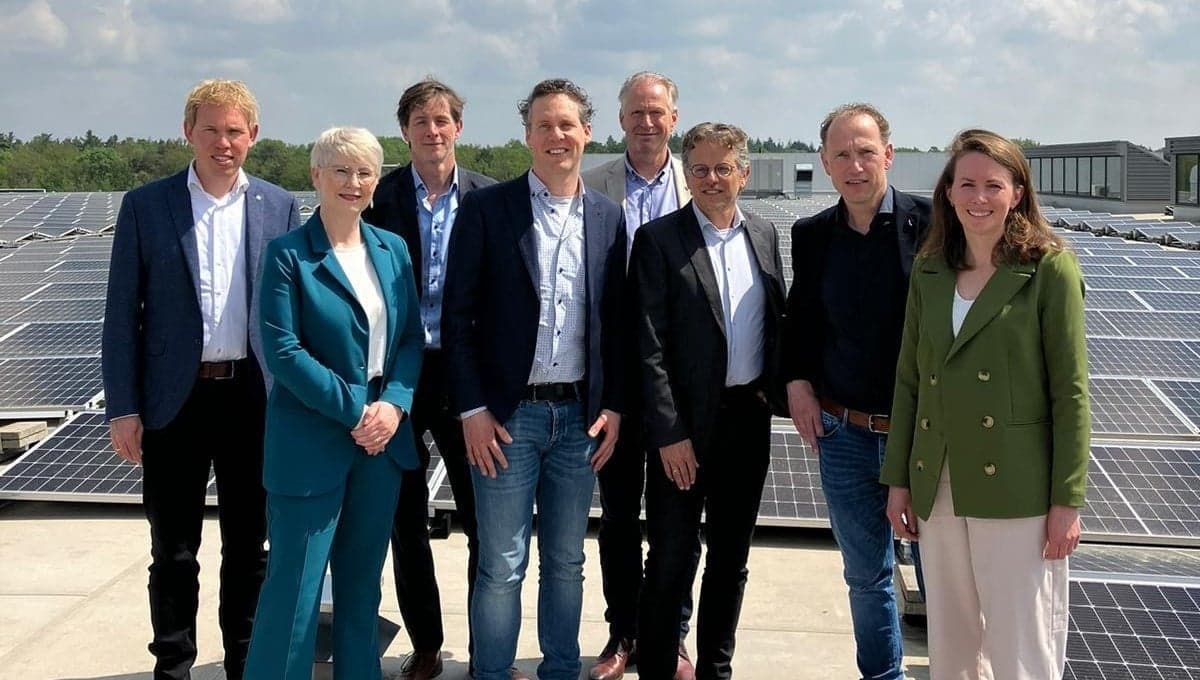
Today, 18 companies at the Hapertse Kempisch Business Park (KBP) sign a cooperation agreement with Enexis for an energy hub. This hub is a pilot project by Enexis, the municipality of Bladel, the Province of North Brabant, and the collaborating companies. The aim of this pilot is for the entrepreneurs, including VDL Groep and VGI Group, to organise their energy supply collectively at the KBP based on sustainable energy sources. They will share energy among themselves as a direct solution to the current grid congestion (traffic jam on the electricity network). The municipality of Bladel is facilitating and supporting this pilot due to the economic interests for the region.
A local energy system must make the involved companies more independent of the limited capacity on the electricity network. In that system, the companies indicate their demand and supply of electricity. The system manages the distribution and payment for the requested electricity. An additional benefit is that local coupling of generation and usage, such as working on KBP, is the best solution for the energy transition because it does not put extra strain on the existing grid. That is the core of an energy hub.
Marco van Geel, chairman of KBP and director of VGI Group, is enthusiastic about this step: “I have established my company on this park and purchased expensive land for it. It quickly became clear that I could not get enough power. Since you are an entrepreneur, you start looking for ways to make that possible. That is why I, together with the other parties involved, have pushed hard for this plan for an energy hub. For our Park and therefore also for me, it is a workable solution. We can all continue to grow and become more sustainable while no one is left without power.”
Deputy Mayor Hetty van der Hamsvoort: ’’The willingness to collaborate is very important in this project. Government and entrepreneurs know how to find each other. That is essential to make this pilot a success. This innovative collaboration is characteristic of the Brainport region. In this way, we stimulate its technological and economic growth. Additionally, as a municipality, we also have significant ambitions in the sustainability of business parks and in generating green energy.’’
For Enexis, it is important that space is created on the KBP network, where it currently does not exist. Bram Gerrist, Director of Innovation, adds: “It was not an easy technical and legal puzzle. The interests of the energy hub as a group, individual companies, and Enexis as the network operator had to come together. The fact that we are all signing today means that it has been successful.”
It was an educational undertaking for the grid operator that serves as a blueprint for the next energy hubs scheduled.
At the end of 2022, a feasibility study was initiated at the Kempisch Business Park regarding the concept and application of an energy hub for the industrial estate. Firan, a new energy infrastructure specialist, mapped out the energy profiles of the established companies during this initial phase, in collaboration with distribution network operator Enexis and the involved companies. André Simonse, Business Developer at Firan: “This is an industrial estate in development with a mix of established companies that want to grow further and new companies to settle. Some companies have excess energy, while others face shortages. In other words, all companies have different energy needs. The ideal mix for the energy hub consists of, on the one hand, energy consumption during the day and at night—such as charging electric trucks—and energy production from solar, wind, and combined heat and power. With this ideal mix, we can supply the industrial estate with (extra) energy throughout the seasons and all weather types. To realize such an energy hub, it’s important that companies adopt a flexible approach, that the municipality adopts an entrepreneurial mindset, and that the grid operator dares to take bold steps. In the case of the Kempisch industrial estate, all these factors came together successfully, allowing all parties to embark on this project.”
The participating companies form a cooperative, which receives a group transport agreement from grid operator Enexis. The companies will share energy among themselves and better coordinate periods of peak consumption. The cooperative is responsible for distributing the energy, aligning needs, and sharing costs. Additionally, the companies will add sustainable energy from a yet-to-be-constructed wind turbine to the hub to increase total capacity. The deployment of large-scale batteries for energy storage provides extra capacity during peak times. For situations where the sun, wind, Enexis's electricity grid, and batteries cannot supply enough energy, a combined heat and power plant can be used.
Communications Director and spokesperson for VDL Groep
E: m.timmers@vdl.nl
Tel: +31 6 14767066
Are you a journalist interested in our work, or would you like to focus on VDL Groep for another reason?
Then please contact us.